Getting someone to buy from your restaurant for the first time is one thing. Getting that same person to return, buy again and eventually recommend your restaurant to other people is another.
For many restaurants in Minna, attracting customers often comes with a familiar routine: post food pictures, announce promotions, reduce prices, share flyers and hope people place orders.
These activities can bring attention and generate sales. But what happens when the promotion ends?
Do those customers still have a reason to come back?
This is one of the important questions restaurant owners need to consider. A restaurant cannot build a sustainable customer base by constantly looking for new people to buy from it. It also needs to give existing customers a reason to return.
At Foody Takeout, our work connecting customers with restaurants has made one thing particularly important to us: the customer’s experience matters. Getting a customer to place an order is only part of the journey. What happens when that order is received, prepared and delivered can influence whether the customer wants to order again.
And that journey starts with the first experience.
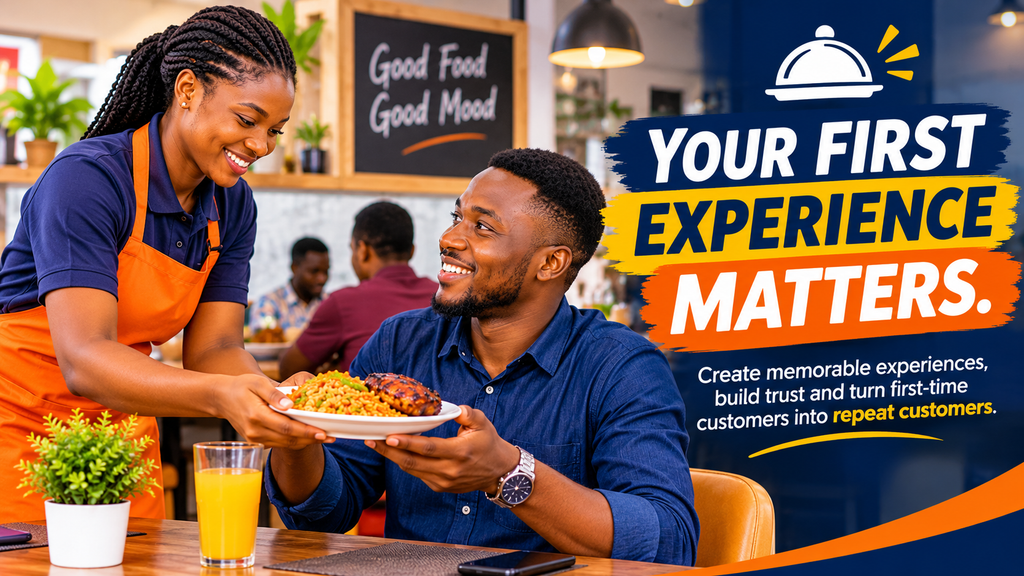
Your first experience with a customer matters more than you think
Think about the first time someone buys food from your restaurant.
They may have discovered you through a friend’s recommendation, a social media post, a roadside sign, an online listing or simply because they walked past your location.
They don’t know you yet. They don’t know whether your food is consistently good, whether your portions are reasonable, whether your staff are welcoming or whether you will handle their order properly.
They are giving your business an opportunity to prove itself.
That first experience creates an impression.
If the food is enjoyable, the portion meets expectations, the staff treat the customer well and the entire experience feels comfortable, you’ve given that person a reason to consider returning.
But if the food disappoints, the order takes unnecessarily long, the staff are rude or the customer feels poorly treated, you may have lost an opportunity before the relationship even begins.
Here’s a simple way to look at it:
The first experience creates the impression. The next experience creates the habit.
You want the customer to leave their first interaction thinking, “I can buy from this restaurant again.”
This is why restaurant owners should not treat first-time customers as ordinary transactions. That first order is an opportunity to introduce the customer to what the business stands for.
1. Don’t just serve the food. Make the experience comfortable.
A customer doesn’t only remember what they ate. They also remember how they were treated.
Imagine two restaurants selling similar meals at similar prices.
At the first restaurant, the customer is welcomed, the person taking the order listens carefully, questions are answered politely and the food is served properly.
At the second restaurant, the customer has to struggle to get attention, the staff respond impatiently and nobody seems concerned about whether the order is correct.
Even if the food tastes good at both places, the experiences are different.
Making customers comfortable doesn’t necessarily require expensive furniture, luxury interiors or a large customer service team.
It can start with simple things:
- Welcome customers when they arrive.
- Listen carefully when they place an order.
- Answer questions without making them feel uncomfortable.
- Treat customers respectfully, regardless of how much they spend.
- Explain delays instead of leaving customers confused.
- Make sure the food they receive is what they ordered.
For online orders, the same principle applies. A customer should be able to understand the menu, place an order without unnecessary difficulty and receive clear communication when something changes.
People appreciate businesses that make things easier for them.
2. Understand that customers return because you solve a need
Let’s use a simple analogy.
Imagine a hungry dog that finds a particular place where it regularly gets food. The reason it returns isn’t necessarily because it wants to greet the person there. It returns because it remembers that the place satisfies its hunger.
Customers are different from dogs, of course, but there’s a useful lesson in that analogy.
People return to restaurants because those restaurants consistently satisfy something they need or want.
They may enjoy the taste of the food, appreciate the portion size, find the prices reasonable, value the convenience or trust the restaurant to prepare their favourite meal properly.
Your restaurant needs to understand what makes customers choose it in the first place.
Is it the taste of your jollof rice? Your affordable lunch options? Your shawarma? Your quick service? Your location? Your ability to handle orders when customers are busy?
Once you understand what customers value, protect it.
Don’t assume that because someone bought from you once, they will automatically return. Give them a reason to remember what your restaurant does well.
3. Consistency is what turns a good first impression into trust
Imagine a customer buys a plate of rice from your restaurant on Monday. They enjoy it so much that they decide to return on Thursday.
But this time, the taste is completely different, the portion is smaller and the overall experience is disappointing.
What happens?
The customer starts questioning whether the first experience was just luck.
This is why consistency matters.
Your food doesn’t have to be identical in every tiny detail, but customers should be able to trust the standard of what they are buying.
Pay attention to:
- The taste and quality of your meals.
- Portion sizes and presentation.
- Food freshness and hygiene.
- Packaging for takeaway and delivery orders.
- Preparation and waiting times.
- How staff communicate with customers.
Consistency also requires systems behind the scenes. Standard recipes, measured ingredients, proper food storage, kitchen procedures and staff training can help reduce unnecessary variation.
A restaurant should not depend entirely on one particular cook or one staff member to maintain its quality.
A customer who trusts what they will receive has a stronger reason to return.
4. Remember that every customer interaction is part of your restaurant’s reputation
Customer experience doesn’t end when the food leaves the kitchen.
Consider a customer who orders food and discovers that something is missing. Perhaps the wrong meal was packed, the delivery took longer than expected or the food arrived in poor condition.
Mistakes happen in businesses. What matters is how the restaurant responds.
Does someone listen to the complaint?
Does the restaurant acknowledge what went wrong?
Does it make a reasonable effort to resolve the problem?
Or does it ignore the customer and hope they never complain again?
A customer who experiences a problem and receives a respectful, responsible response may still be willing to give the restaurant another opportunity.
But ignoring complaints can turn a small operational mistake into a lasting negative impression.
Restaurants should make it easy for customers to raise concerns. They should also pay attention to repeated complaints because those complaints may reveal a problem in the business.
Don’t treat feedback as an attack. Sometimes, it is information that can help you improve.
5. Make it easy for customers to buy from you again
Sometimes, customers don’t return simply because buying from a restaurant is inconvenient.
Think about a customer who enjoyed your food but cannot remember your phone number, doesn’t know your opening hours, cannot find your menu or has to send several messages before getting a response.
You may have won that customer once, but you are making the next purchase unnecessarily difficult.
Make the next order easier.
For a physical restaurant, this could mean displaying your menu clearly, providing accurate contact information and making your ordering process straightforward.
For a restaurant that accepts online orders, it could mean maintaining an updated digital menu, displaying prices, confirming orders promptly and providing clear information about delivery or collection.
Your restaurant should also make its online presence useful. Customers should not have to search through weeks of social media posts just to find out what you sell.
If someone wants to order your food again, the process should be simple.
Convenience is part of the product you’re offering.
6. Build relationships with regular customers
There is a difference between knowing that someone bought from your restaurant and actually understanding your customers.
You don’t need a complicated customer relationship management system to start building better relationships.
Pay attention to the people who return.
When appropriate, remember regular customers and their preferences. If someone frequently orders a particular meal, make it easier for them to find it. If a customer raises a concern, follow up when possible.
You can also ask simple questions:
- How was your last meal?
- Was the portion enough?
- What would you like us to add to the menu?
- Is there anything we could improve about your experience?
These questions can help you understand what customers value.
However, don’t confuse building relationships with making customers feel watched or overwhelming them with messages. Communicate respectfully and only use customer information in ways they have agreed to.
The objective is simple: make customers feel that their patronage matters.
7. Use discounts and loyalty rewards carefully
Discounts are not necessarily bad.
They can help introduce a new meal, attract customers during a slow period or encourage someone to try a restaurant for the first time.
The problem begins when discounts become the only reason people buy from you.
If customers only return when your prices are reduced, you may be training them to wait for the next promotion.
Instead, think about other ways to appreciate returning customers.
For example:
- Give a regular customer an occasional complimentary extra.
- Offer a simple loyalty programme where repeat purchases earn a reward.
- Give customers a small birthday treat when they have opted into receiving such offers.
- Introduce referral rewards for customers who bring in new buyers.
- Give returning customers early access to a new menu item.
- Thank customers genuinely for their continued patronage.
These gestures don’t have to be expensive. The important thing is that they feel thoughtful and are financially sustainable for the restaurant.
Before introducing any reward, understand your costs. A loyalty programme should encourage repeat purchases without quietly eating into your profit.
8. Don’t forget the customers who order online
Restaurant owners sometimes focus so much on customers who walk into their premises that they overlook people ordering remotely.
But someone ordering from a hostel, office, home or another location is still your customer.
They may never see your kitchen or interact with your staff face-to-face. Their entire impression of your restaurant may come from your digital menu, the ordering process, the food packaging, the communication they receive and the condition of the meal when it arrives.
This means online ordering requires the same attention to customer experience.
Make sure your menu is accurate. Confirm what the customer ordered. Prepare the meal properly. Package it carefully. Communicate when there are delays.
Where a food marketplace or ordering platform is involved, restaurants should also pay attention to how they manage orders received through that platform.
At Foody Takeout, we believe technology should make the connection between customers and restaurants easier. But the technology alone cannot guarantee a great meal or a good customer experience. The restaurant still has an important responsibility to deliver on what it promises.
A good digital ordering experience and a good restaurant experience should work together.
9. Measure whether customers are actually returning
One mistake restaurant owners make is judging business performance only by how many orders they receive today.
Today’s sales matter, but they don’t tell the whole story.
You should also try to understand how many customers come back.
Start tracking simple information:
- How many customers are buying for the first time?
- How many customers have purchased more than once?
- Which meals are customers ordering repeatedly?
- How often do customers complain?
- Why do customers cancel or abandon orders?
- Which promotions bring customers who actually return?
You don’t need expensive software to begin. A well-maintained spreadsheet or a simple customer-order record can help you identify patterns.
For example, if you discover that many first-time customers never make a second purchase, investigate why.
Is the food inconsistent? Are prices unclear? Is the ordering process difficult? Are orders frequently delayed? Is there no convenient way for customers to order again?
Don’t immediately assume that you need another promotion.
Sometimes, the problem is not that customers haven’t seen your restaurant. It’s that their first experience hasn’t given them a strong enough reason to return.
10. Build a restaurant people want to recommend
Repeat customers are valuable, but customers who recommend your restaurant can introduce you to entirely new people.
Think about what happens when someone genuinely enjoys a meal.
They may tell a friend, recommend the restaurant to a coursemate, share a food picture or mention it in a WhatsApp group.
That recommendation is more meaningful when it comes from a real experience rather than a promotion.
You cannot force customers to recommend your restaurant. But you can create conditions that make them comfortable doing so.
Deliver what you promise. Treat people well. Maintain food quality. Resolve problems responsibly.
And when customers give you positive feedback, you can politely ask whether they would be willing to leave a review or recommend your business.
Your reputation is built through many individual customer experiences.
Final thoughts: Your next loyal customer may be placing their first order today
For restaurant owners in Minna and across Nigeria, customer retention shouldn’t be treated as something to think about only after a business becomes popular.
It starts with the next person who walks into your restaurant or places an order online.
Don’t look at that person and see only today’s sale. See an opportunity to build a relationship with someone who may return many times.
Make their first experience comfortable. Give them food that meets their expectations. Treat them with respect. Make ordering convenient. Listen when they have something to say.
Then work hard to maintain that standard.
You don’t have to offer a discount every week to remind customers that your restaurant exists.
Sometimes, the strongest reason for someone to return is simply knowing that they enjoyed their last experience and can trust you to deliver it again.
Don’t just work to get customers through the door. Give them a reason to come back.
This article is published by Foody Takeout, a technology-driven food marketplace connecting customers with restaurants in Gidan Kwano, Minna.