A customer wants to eat something different today.
They pick up their phone and search for a restaurant in Minna. Maybe they type “restaurants near me”, “where can I get good shawarma in Minna?”, or “best places to eat in Gidan Kwano.”
Another customer does something slightly different. They open an AI assistant and ask:
“Can you recommend a restaurant in Minna where I can get good food?”
Now, here’s the important question:
If someone searches for the food your restaurant sells, will your business appear anywhere they can find it?
You might prepare excellent meals. Your customers might love your food. People who have visited your restaurant might even recommend you to their friends.
But what happens when someone who has never heard of your business starts searching online?
Can they find your restaurant? Can they see your location, opening hours, menu and prices? Can they tell what kind of food you serve? Can they find genuine customer feedback? And, most importantly, can they easily place an order or contact you?
These are questions every restaurant owner and food entrepreneur should be thinking about.
The way customers discover food businesses is changing. Word of mouth and social media remain important, but Google Search, Google Maps and AI-powered search experiences are also becoming part of how people decide where to eat.
For restaurants in Minna, this creates an opportunity: make your business easier to discover, easier to understand and easier to choose.
Let’s look at how to do that.
1. Understand what happens before a customer visits your restaurant
A customer does not always discover a restaurant by walking past it.
Sometimes, the journey begins with a search.
Someone might be looking for:
- A restaurant close to their hostel.
- A place to buy rice, beans or swallow.
- A shawarma or grilled chicken vendor.
- A restaurant that offers affordable meals.
- A place that is open late.
- A food business that accepts online orders.
- A restaurant that delivers to their location.
Notice something about these searches: customers are not necessarily searching for your restaurant’s name. They are searching for a solution to a need.
This is why simply having an Instagram account with your restaurant’s name may not be enough.
Your online presence should help customers understand what you sell, where you operate, who you serve and how they can buy from you.
Think about the questions a first-time customer would ask. Your digital presence should answer as many of them as possible.
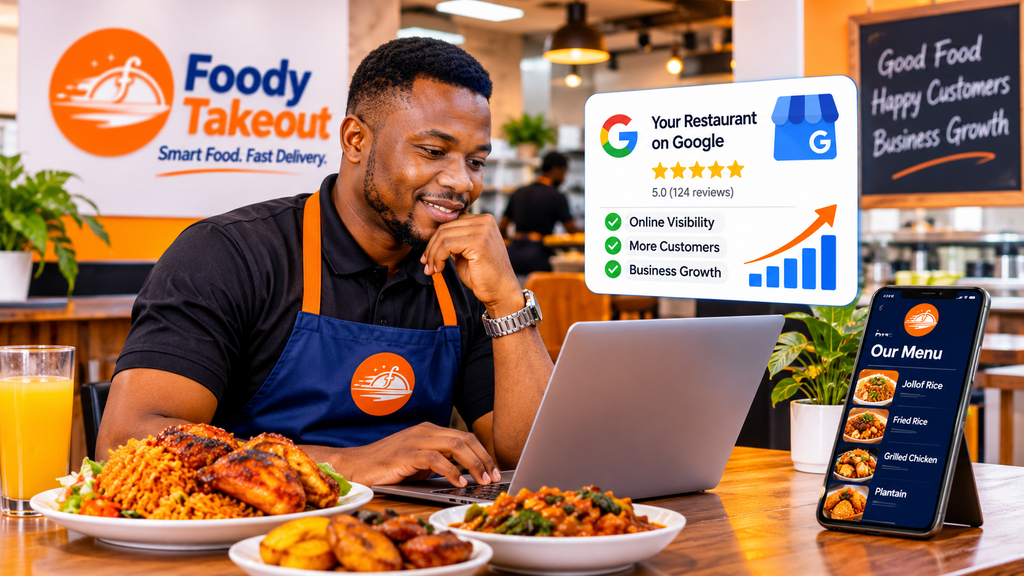
2. Set up and properly manage your Google Business Profile
One of the most important starting points for local restaurant visibility is your Google Business Profile.
It is the business information that can appear when people search for your restaurant on Google Search or Google Maps.
Imagine someone searching for a restaurant around their current location. A properly maintained business profile can help them discover your restaurant and access useful information without having to search through several social media pages.
If you have not claimed or verified your business profile, make that a priority.
If you already have one, do not assume that creating it is enough. It needs to be maintained.
Here are the details you should pay attention to:
Business name: Use your actual business name consistently. Avoid stuffing unrelated keywords into your name just to attract searches.
Business category: Select the most accurate primary category for your business. Add relevant additional categories only where they genuinely describe what you do.
Address or service area: Make your operating location clear. If customers can visit your restaurant, provide the correct address. If you operate from a home kitchen or do not receive customers at your premises, check Google’s rules for service-area businesses rather than publishing a misleading address.
Opening hours: Keep your opening and closing times accurate. Update special hours when necessary.
Phone number and contact details: Make it easy for customers to reach you.
Menu and website: Where available, provide a working menu link and website link.
Photos: Upload clear, genuine photographs of your food, restaurant environment, packaging and other relevant aspects of your business.
A customer should not have to guess whether your restaurant is still operating, where it is located or what you sell.
Google explains that local results are primarily influenced by relevance, distance and prominence. Complete business information helps Google understand how relevant your business is to a search. Distance also matters, and prominence can be influenced by things such as reviews and links from other websites.
There is no legitimate shortcut that guarantees the top position. Start by making your business information accurate and useful.
3. Make your menu discoverable beyond Instagram and WhatsApp
This is one area where many food businesses can improve.
You might have a beautiful menu design on Instagram. You might share your menu every morning on WhatsApp Status. Your customers might even have saved the menu image on their phones.
But what happens when someone searches Google for one of the meals you sell?
Can a search engine understand that your restaurant offers that meal?
A menu that exists only as a photograph or a social media post can be harder for search engines and other discovery systems to understand than a properly organised, accessible menu page.
For example, imagine your restaurant sells:
- Jollof rice.
- Fried rice.
- Spaghetti.
- Beans and plantain.
- Grilled chicken.
- Shawarma.
- Fresh juice.
Instead of relying only on a menu image, create a dedicated menu page on your website or an accessible digital menu that clearly lists the items.
Where possible, include:
- The exact meal name.
- A short and accurate description.
- The price.
- A clear food photograph.
- Available portion or size options.
- Whether the item is currently available.
- How customers can order.
Do not hide important menu information inside an image when you can publish it as readable text.
Also, keep your menu updated. An online menu showing meals you no longer prepare can frustrate customers and damage trust.
Your menu is not just a list of food. It is part of how customers discover and evaluate your business.
4. Create a website or a proper online page for your restaurant
You do not necessarily need an expensive website with complicated animations and dozens of pages.
You need a useful online destination that explains your business.
A restaurant website or landing page can include:
About the restaurant: Explain who you are, what you serve and what makes your food business distinctive.
Menu: Display your available meals and current prices.
Location: State the actual area where you operate and provide directions where appropriate.
Opening hours: Make your operating schedule clear.
Contact information: Provide a working phone number or WhatsApp contact.
Ordering information: Explain how customers can place an order, whether through your website, a food marketplace or directly with your business.
Food photographs: Use genuine images of your meals rather than unrelated stock photographs.
A website also gives you a place to publish useful information about your food, menu, location and services.
For example, a restaurant in Minna that specialises in grilled food could publish a page explaining its grilled food menu, where it operates and how customers can order.
That page gives search engines more useful context than a social media bio that simply says, “We sell delicious food.”
If you cannot build a full website immediately, start with a complete Google Business Profile, a clear digital menu and consistent contact information. Improve your online presence gradually.
5. Use the words your customers actually search for
Your restaurant may have a unique brand name, but customers who do not know you yet are unlikely to search for that name.
They may search for the food they want or the area where they want to find it.
Consider these examples:
- Restaurants in Minna.
- Food vendors in Gidan Kwano.
- Shawarma in Minna.
- Affordable food in Gidan Kwano.
- Where to buy rice in Minna.
- Restaurants near FUT Minna.
- Grilled fish in Minna.
These are examples of search phrases, not guaranteed high-volume keywords. The point is to understand the language customers use when looking for food.
Use relevant phrases naturally in your website content, menu descriptions, business profile and useful social media posts.
For example, instead of writing:
“We sell the best food. Come and patronise us.”
You could write:
“Looking for freshly prepared rice meals in Gidan Kwano? Our restaurant serves jollof rice, fried rice and other meals for students and residents. Contact us to check today’s menu and availability.”
The second description gives a potential customer—and a search system—more meaningful information.
But do not repeat the same keyword in every sentence. Write for people first. Make the location and service information clear without making your content sound unnatural.
6. Collect genuine customer reviews and respond to them
Imagine choosing between two restaurants.
One has a complete business profile, recent food photographs and genuine customer reviews. The other has almost no information and no visible feedback.
Which one would you feel more comfortable trying?
Reviews help potential customers understand other people’s experiences.
Encourage customers who have actually purchased from you to leave honest feedback. You can share your Google review link after a successful order or display a small notice at your restaurant.
Do not buy reviews, create fake customer accounts or pressure people to leave only positive feedback.
And do not ignore the reviews after receiving them.
When someone leaves a review:
- Thank customers for positive feedback.
- Respond professionally to complaints.
- Acknowledge genuine mistakes.
- Explain how you intend to improve where appropriate.
- Avoid arguing with customers publicly.
- Never expose private customer information in a public response.
A thoughtful response can show future customers that your restaurant takes feedback seriously.
Remember that reviews are not just about getting a high rating. They are also about building confidence.
7. Publish useful food content, not only promotional flyers
Let’s be honest: most restaurant social media pages look very similar.
A food photograph, a price, a phone number and the familiar “Place your order now.”
There is nothing wrong with promotional content. Restaurants need to sell.
However, if every post is simply an advert, you miss opportunities to help people discover your business through useful information.
Try creating content around questions customers might already have.
For example:
- What makes your grilled chicken different?
- How do you prepare your signature meal?
- What meals are available for lunch?
- What is the difference between two items on your menu?
- How can customers order from your restaurant?
- Where exactly is your restaurant located?
- What should a first-time customer try?
You can also create short videos showing food preparation, packaging, the restaurant environment and available meals.
For a restaurant in Minna, local context matters. Mention the area you genuinely serve and explain how customers can reach you.
You are not just filling your social media calendar. You are creating useful information that can help someone discover and understand your restaurant.
8. Make your restaurant understandable to AI search tools
This is where the conversation is becoming particularly interesting.
People are increasingly using AI assistants to ask questions such as:
- “Recommend affordable restaurants around Gidan Kwano.”
- “Where can I get shawarma in Minna?”
- “Which restaurants serve rice meals near FUT Minna?”
- “What food businesses deliver around my area?”
An AI assistant may use available information from websites, business listings and other sources to formulate an answer.
This does not mean there is a secret button you can press to make your restaurant appear in every AI recommendation.
There is no guaranteed way to force an AI assistant to recommend your business.
But you can make your business information clearer, more consistent and easier for digital systems to interpret.
Here are some practical steps:
Describe your business clearly. State your restaurant’s name, location, type of food, services and operating hours in plain language.
Keep your information consistent. Your business name, address, phone number, website and opening hours should not contradict one another across your website and business listings.
Publish your menu as readable content. Include actual meal names and descriptions rather than depending entirely on photographs.
Create useful location-specific pages. If you genuinely serve customers in a particular area, explain that clearly. Do not claim to operate in locations you do not serve.
Build a trustworthy online presence. Genuine reviews, real photographs, accurate listings and useful third-party mentions can help people understand your business.
Use structured data where appropriate. If you have a website, a web developer can implement Restaurant or LocalBusiness structured data. This can help search engines interpret information such as your business name, address, opening hours, cuisine and menu.
Structured data is not a magic ranking tool. It does not guarantee that your restaurant will appear in a special search result or an AI-generated answer. Its purpose is to describe information in a standard format.
The bigger principle is simple:
If people and digital systems cannot clearly understand what your restaurant does, where it operates and what it offers, recommending it becomes more difficult.
9. Make sure customers can actually place an order
Visibility is important, but visibility alone does not grow a restaurant.
A customer might discover your business, view your menu and decide they want to buy something.
Then they encounter a problem:
- Your contact number is not working.
- Your WhatsApp link is broken.
- Your menu has no prices.
- They cannot tell whether an item is available.
- Nobody responds to their message.
- They do not know whether delivery is available.
- They are unsure how to pay.
That customer may simply move on.
Review your ordering process from the customer’s perspective.
Can someone who has never purchased from you understand exactly what to do?
Make your ordering instructions clear. Respond to enquiries promptly. Confirm availability before accepting payment. Explain delivery arrangements and any applicable charges. Keep customers informed about their orders.
If you sell through a food marketplace, make sure your restaurant profile and menu are properly maintained there too.
Your digital presence should not stop at getting attention. It should provide a clear route from discovery to purchase.
10. Build visibility outside your own social media accounts
Your restaurant’s Instagram or Facebook page is useful, but your entire digital presence should not depend on one platform.
Think about other places where people may encounter your business:
- Google Business Profile.
- Local business directories.
- Your own website.
- Food marketplaces.
- Genuine local publications and blogs.
- Community websites.
- Customer reviews and recommendations.
- Relevant partnerships with businesses and organisations.
For example, a food business operating in Gidan Kwano could benefit from being accurately represented on platforms that help people discover food options in that community.
The important thing is to avoid creating dozens of low-quality listings just for the sake of having links.
Prioritise platforms that real customers use. Keep your information accurate and make sure every listing points to the correct business.
11. Measure what is working instead of guessing
You do not need a complicated analytics department to start understanding your online visibility.
Begin by tracking a few practical numbers every month.
Discovery
- How many people viewed your Google Business Profile?
- How many people found your website?
- Which search terms brought people to your pages?
Customer interest
- How many people clicked to call?
- How many requested directions?
- How many clicked your menu or ordering link?
- How many enquiries came through WhatsApp?
Sales
- How many online enquiries became orders?
- Which meals generated the most orders?
- How many customers returned?
- Which channels brought customers who actually purchased?
Google Business Profile provides performance information for eligible profiles. Google Search Console can also help website owners understand how their pages appear in Google Search.
Do not confuse views with sales. A post can receive hundreds of views without generating an order.
The goal is to understand which activities bring the right customers and which parts of the customer journey need improvement.
12. A practical 30-day visibility plan for your restaurant
If you are a restaurant owner and all of this sounds like a lot, don’t try to fix everything in one day.
Start with a simple plan.
Week 1: Fix your business information
- Claim or verify your Google Business Profile.
- Check your business name and category.
- Correct your location and opening hours.
- Add your working phone number and website or menu link.
- Upload genuine photographs of your restaurant and food.
Week 2: Improve your menu and ordering experience
- Create or update your digital menu.
- Add meal names, descriptions and current prices.
- Remove unavailable items.
- Check that your contact and ordering links work.
- Ask someone unfamiliar with your business to test the ordering process.
Week 3: Build trust and publish useful content
- Ask recent customers for honest reviews.
- Respond to existing reviews.
- Publish food photographs and short videos.
- Share useful information about your menu and location.
- Make sure your business information is consistent across platforms.
Week 4: Review your performance
- Check your Google Business Profile performance.
- Review website traffic if you have a website.
- Track enquiries and completed orders.
- Identify the content and channels that generated genuine interest.
- Decide what to improve in the following month.
Consistency is more useful than doing everything once and abandoning it.
13. Where Foody Takeout fits into this picture
At Foody Takeout, we believe technology should make it easier for customers to discover food businesses and place orders.
That is part of why we are building a technology-driven food marketplace that connects customers, restaurants and Foody riders.
For restaurants operating in Gidan Kwano, Foody Takeout provides another digital channel through which customers can discover available restaurants, browse menus and place orders.
Our restaurant partners can manage their menus and orders through the restaurant side of the platform. Customers can browse available restaurants and meals before creating an account to place an order.
Our current restaurant partnership model has:
- 0% commission on restaurant orders.
- No restaurant joining fee.
- Foody Takeout manages the delivery process within its current service area.
- Customers pay the applicable delivery fee.
Foody Takeout currently operates in Gidan Kwano, Minna. Our current delivery fee is ₦700 within the service area, and delivery estimates are approximately 25 minutes and above, depending on the order and operating conditions.
We are not claiming to serve every part of Minna yet. Our immediate focus is to serve Gidan Kwano properly while building the systems and partnerships needed for the future.
For restaurants in our current operating area, joining a digital food marketplace can be another way to make their menus accessible to customers who prefer to discover and order food online.
You can explore Foody Takeout at foodytakeout.com.
Final thoughts: Good food deserves to be discoverable
Running a restaurant takes more than preparing good food.
You have to manage ingredients, staff, customer expectations, pricing, operations and daily sales. Adding digital visibility to that list can feel like another responsibility.
But consider this:
Someone in your neighbourhood may be searching for exactly what you sell right now.
They may be looking for your signature meal. They may be searching for a restaurant close to their hostel. They may even be asking an AI assistant to recommend somewhere to eat.
The question is whether your business has enough accurate, useful and trustworthy information online for that person to discover it.
You do not need to become a technology expert overnight. Start with your business information. Make your menu accessible. Collect genuine reviews. Publish useful content. Make ordering straightforward. Then measure what works.
Your restaurant’s online presence should work for you even when you are busy in the kitchen.
Good food deserves to be discovered. Make it easier for people to find yours.
Frequently Asked Questions
1. How can I get my restaurant on Google Maps in Minna?
Start by creating or claiming your Google Business Profile, selecting the correct business category and providing accurate business information. Complete the verification process where required, then keep your address or service area, hours, contact details and photographs up to date.
2. Does a restaurant need a website to appear on Google?
A website is useful, but it is not a requirement for every restaurant to have a Google Business Profile. A complete and verified profile can help customers discover a business on Google Search and Maps. A website gives you more control over your menu, business information and content.
3. How can my restaurant appear in AI search recommendations?
There is no guaranteed method. Make your business information accurate and consistent, publish an accessible menu, explain your location and services clearly, maintain genuine reviews and build a useful online presence. These steps help people and digital systems understand your restaurant.
4. What is local SEO for restaurants?
Local SEO is the process of improving how easily people can discover a restaurant when searching for food businesses in a particular area. It includes Google Business Profile management, accurate location information, relevant website content, genuine reviews and other local visibility signals.
5. Can a small food vendor benefit from SEO?
Yes. A small restaurant, takeaway, café or home-based food business can start with accurate business information, a clear menu, useful photographs and a suitable online presence. The most important thing is to provide truthful information about where the business operates and how customers can order.
6. Does Foody Takeout accept restaurants in Minna?
Foody Takeout currently operates in Gidan Kwano, Minna. Restaurants interested in joining should contact the team to discuss the current service area and onboarding requirements. The current restaurant partnership model has no joining fee and 0% commission.